
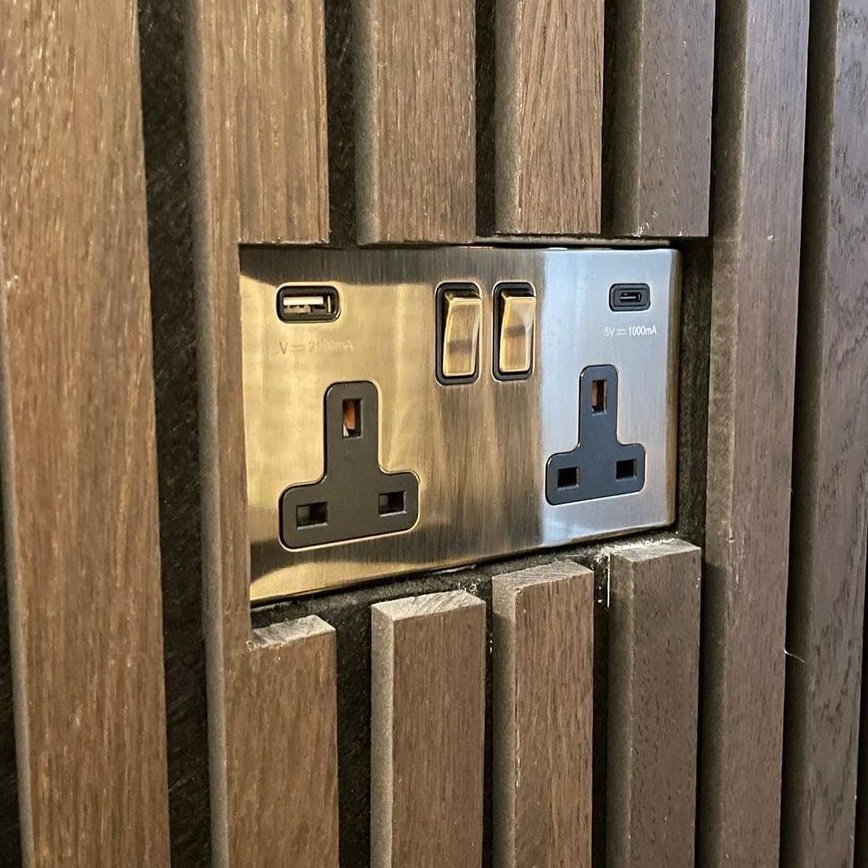
Building a media wall is a rewarding project that transforms a living space, creating a sleek, modern hub for entertainment. However, this popular home improvement project presents a common and frustrating challenge: electrical back boxes that end up deeply recessed behind new layers of timber framing, acoustic slats, or decorative panelling. This leaves sockets and switches feeling loose, wobbly, and unsafe, with unsightly gaps that expose internal wiring. Learn how to select and fit the ideal extension frame to resolve sunken back boxes and ensure a professional, flush finish on your media wall project.
Whilst generic solutions like stacking thin plastic shims might seem like a quick fix, they often create more problems than they solve. For a media wall, where precision and aesthetics are paramount, a dedicated deep back box extension frame is the only way to guarantee a secure, safe, and visually perfect result. This guide will walk you through everything you need to know about choosing, measuring for, and installing the right socket spacer for your media wall.
Table of Contents
- What is a Deep Back Box Extension Frame?
- Key Considerations When Selecting an Extension Frame
- Bespoke Frames versus Generic Spacers: Finding the Right Fit
- How to Measure and Install an Extension Frame for a Professional Result
- Custom Solutions: Why Bespoke Extension Frames Outperform Off-the-Shelf Parts
What is a Deep Back Box Extension Frame?
A deep back box extension frame, often called a socket spacer or pattress box extender, is a crucial component for any media wall installation. It is a custom-made frame that precisely fills the gap between a back box that is set too far into the wall and the final surface where the socket or switch faceplate will sit. Its design ensures a stable and professional finish where standard parts fail.
- An extension frame acts as a structural bridge between a recessed electrical back box and the socket faceplate.
- Its primary function is to enclose internal wiring securely whilst providing a solid mounting surface.
- Unlike thin spacers, a deep extension frame handles significant gaps created by media wall stud work.
- This component is essential for maintaining electrical safety and fire resistance in domestic installations.
The Importance of Enclosing Exposed Wiring
Leaving a gap between the electrical back box and the socket faceplate is not just an aesthetic issue; it is a significant safety risk. UK building standards and electrical regulations are clear about the need for continuous enclosure around wiring to prevent fire and electric shock. An extension frame restores this protective barrier.
- Preventing Fire and Electrical Hazards: Gaps can allow sparks from a faulty connection to contact flammable materials within the wall cavity, such as timber studs or dust. A properly fitted frame contains any potential issues within the fire-resistant enclosure.
- Blocking Dust and Debris: Over time, dust, debris, and even insects can accumulate inside an exposed back box. This build-up can interfere with connections, cause short circuits, and create a fire hazard. The frame seals the enclosure, keeping it clean and safe.
- Meeting UK Building Standards: For an electrical installation to be considered safe and compliant, all wiring and terminals must be fully enclosed. A bespoke extension frame ensures your media wall project meets these essential legal and safety requirements.
Extension Frames in the Context of Media Walls
Media walls present unique challenges that standard electrical accessories are not designed to handle. The construction often involves building a new timber frame in front of an existing wall, which can add 50mm or more of depth. When you add decorative finishes like acoustic slat panels or tiles, the back box can be recessed by a significant distance.
- Bridging Deep Gaps: A deep extension frame is specifically designed to bridge the substantial depth created by acoustic slats, timber panelling, and stud work. It provides a solid, continuous structure where small, stacked shims would fail.
- Ensuring Stability for Heavy Plugs: Media walls house sockets for large TVs, sound systems, and gaming consoles, all of which use heavy plugs and transformers. A secure extension frame prevents the socket from flexing or pulling away from the wall under this weight, protecting the wiring from strain.
- Achieving a Professional Finish: You have invested time and money into creating a high-end media unit. A wobbly socket with visible gaps completely undermines this aesthetic. A colour-matched, precision-fit frame provides a seamless, integrated look that complements the quality of your build.
Key Considerations When Selecting an Extension Frame
Choosing the right extension frame is vital for a successful outcome. Off-the-shelf solutions, such as the fixed 32mm spacers found at trade counters, are rarely suitable for the custom nature of a media wall. These fixed depths often result in the socket either protruding from the wall or leaving a small but noticeable gap. For a perfect result, you need to consider the specific requirements of your project.
- Gang Configuration: First, identify the size of the back box you need to extend. Is it for a single socket, a double socket, or a more complex multi-gang plate that combines power with data or HDMI ports?
- Depth Requirements: The most critical factor is the depth. For a truly flush finish, the frame must be measured to the nearest millimetre. This precision is the key difference between a DIY look and a professional installation.
- Material and Durability: For interior domestic use, high-quality plastics like PETG offer the ideal combination of strength, durability, and fire resistance. They are robust enough to provide a secure mounting surface without being brittle.
- Colour Matching: The frame should be an invisible part of the final installation. Selecting a finish that complements your faceplates or wall colour ensures it blends in seamlessly, especially on dark or feature media walls.
Gang Sizes and Faceplate Compatibility
The term 'gang' refers to the number of switch or socket positions on a faceplate. Ensuring your extension frame matches your faceplate's configuration is essential for a perfect fit.
- Standard UK Sizes: Most UK installations use standard single gang (approx. 86mm x 86mm) or double gang (approx. 146mm x 86mm) faceplates. Your extension frame must match these dimensions precisely to sit neatly behind the plate.
- Bespoke Media Plates: Media walls often feature custom faceplates that combine power sockets, USB chargers, HDMI ports, and Ethernet connections in a single unit. These multi-gang plates require a bespoke extension frame manufactured to their exact dimensions.
- Matching Corner Radius: A subtle but important detail is the corner radius of the frame. Modern screwless or decorative faceplates often have a sharper, more defined corner than standard white plastic sockets. A bespoke frame can be made to match this radius for a truly seamless appearance.
Aesthetic Integration and Colour Choice
On a feature media wall, every detail matters. The colour and finish of your electrical fittings can either enhance or detract from the overall design.
- Impact on Dark Walls: On a dark-painted or panelled media wall, a standard white spacer creates a jarring white line around the socket. This visual disruption draws the eye and cheapens the look of the entire project.
- Popular Modern Finishes: Black, grey, and anthracite frames are increasingly popular for modern UK interiors. They coordinate perfectly with the black or grey sockets and switches often used in contemporary designs, creating a cohesive and sophisticated look.
- Finding the Perfect Match: To achieve a flawless finish, you need control over the exact colour and dimensions. You can use the Build My Spacer tool to select the precise size and colour for your project, ensuring a perfect match every time.
Bespoke Frames versus Generic Spacers: Finding the Right Fit
When faced with a sunken back box, many people first reach for a multi-pack of thin 2mm or 5mm plastic shims from a DIY store. Whilst this might seem like a cost-effective solution, it is a false economy. Stacking loose spacers is structurally weak, difficult to install, and results in a poor aesthetic finish. For a project as prominent as a media wall, a single, solid bespoke frame is a far superior choice.
- Structural Limitations: Stacked plastic shims are not designed to bridge deep recesses. They can shift, compress, or crack over time, causing the socket to become loose.
- Superior Stability: A single, solid bespoke frame provides a robust and stable platform. This is particularly important for smart home switches or sockets with USB ports, which require frequent interaction.
- Cost-Benefit Analysis: Whilst a bespoke frame has a higher initial cost than a pack of shims, it saves significant time and frustration during installation. The value it adds through a professional, safe, and durable finish far outweighs the small upfront saving of a DIY workaround. For a more detailed comparison, explore our guide on professional spacers versus DIY shims.
- The Professional Finish: There is a reason architects and high-end installers specify bespoke frames. They understand that the small details make the difference. A precision-engineered part guarantees a flawless result that reflects the quality of the overall build.
The Problem with Stacking Spacers
Using a stack of thin, generic spacers introduces multiple points of failure into your electrical installation. This approach is prone to several issues that a single, solid frame solves.
- Instability and Movement: Each layer in a stack of shims is a potential point of movement. When you plug and unplug appliances, the socket can click or shift, putting strain on the electrical connections and eventually working loose.
- Difficult Screw Alignment: Aligning the faceplate screw holes through multiple loose components and into the back box lug can be extremely frustrating. It is easy for one layer to shift, making it nearly impossible to get the screws to engage properly.
- Poor Aesthetics: The edges of stacked spacers are never perfectly aligned, creating visible, ugly seam lines around the socket. This inconsistent edge detracts from the clean lines of a modern media wall.
The Advantage of Precision Engineering
A bespoke extension frame is engineered to solve a specific problem with precision. This approach offers clear advantages over generic, one-size-fits-all parts.
- A Perfect Fit Every Time: Bespoke manufacturing means your frame is made to the exact depth of your wall finish, down to the millimetre. Whether you have 12mm plasterboard and 18mm acoustic slats, you get a frame that fills the gap perfectly.
- Accommodating Non-Standard Back Boxes: Older properties may have back boxes with non-standard screw positions or fixing lugs. A custom frame can be designed to accommodate these irregularities, ensuring a secure fit where off-the-shelf parts would not work.
- Ease of Ordering: With online tools, ordering a custom part is straightforward. Reputable suppliers like SocketSpacers.com allow you to specify your exact requirements for a part that is tailored to your unique project.
How to Measure and Install an Extension Frame for a Professional Result
Achieving a flush, professional finish is entirely dependent on accurate measurement. Taking a few moments to measure correctly will ensure your bespoke frame fits perfectly and is simple to install.
- Essential Tools: For millimetre accuracy, avoid using a tape measure. A digital calliper or a dedicated depth gauge is the best tool for the job. You will also need a screwdriver and a spirit level.
- The Measurement Process: The key measurement is the distance from the front face of the back box's screw lug to the final, finished wall surface. This single dimension is the required thickness of your extension frame.
- Preparation: Before measuring, ensure the back box is clean and free of any plaster, dust, or debris that could affect your measurement. The surface you measure from must be the metal lug itself.
- Final Installation: Installation is simple. The frame sits over the back box, and the faceplate is placed on top. Long fixing screws then pass through the faceplate and the frame, securing everything tightly to the back box lug.
Accurate Measurement for Media Walls
The surfaces on media walls, especially those with slat panels or tiles, can be uneven. It is important to measure carefully to account for any variations.
- Measure at Multiple Points: Take your depth measurement at both the top and bottom screw holes of the back box. If the wall surface is uneven, the depths may differ slightly. Use the largest measurement to ensure the faceplate does not get pulled into the wall and distort.
- Calculating for Acoustic Slats: When working with acoustic slat panels, ensure you are measuring to the highest surface where the edge of the socket faceplate will sit, not the recessed felt backing. For a detailed walkthrough, see our guide to spacers for panelled walls.
- Inputting Your Measurements: Once you have your precise depth in millimetres, you can enter it directly into a design tool. The configurator at SocketSpacers.com/build allows you to input your exact measurements for a frame that is made to order for your project.
Installation Tips for a Secure Fit
With your custom frame in hand, a secure and safe installation takes only a few minutes. Following these tips will ensure a robust and lasting result.
- Select the Correct Screws: Your original faceplate screws will be too short. You will need longer electrical screws (typically M3.5) that are long enough to pass through the faceplate and the extension frame, and still engage with at least 5-6 full turns into the back box lug.
- Avoid Over-Tightening: Tighten the screws until the faceplate is snug and secure against the frame. Over-tightening can crack the frame, the faceplate, or strip the threads in the back box lug. The aim is for a firm fit, not maximum force.
- Safety First: Before starting any work, always isolate the power to the relevant circuit at your consumer unit (fuse box). Use a voltage tester to confirm that the power is off before touching any wires or terminals. If you are in any doubt, consult a qualified electrician.
Custom Solutions: Why Bespoke Extension Frames Outperform Off-the-Shelf Parts
Every media wall project is unique. The specific combination of framing, panelling, and finishes means that a one-size-fits-all solution is rarely the best one. Bespoke manufacturing provides the flexibility and precision needed to achieve a truly high-end finish, saving you time and ensuring a safer installation.
- Unmatched Flexibility: Bespoke manufacturing can accommodate unusual gang counts, extreme depths, or non-standard dimensions, providing a perfect solution for any complex media wall installation.
- Time-Saving for Professionals: For professional electricians and installers, a custom-made part saves valuable time on site. There is no need for makeshift solutions or fiddly adjustments; the part fits perfectly first time.
- Environmental Benefits: Ordering a part made to the exact size you need eliminates the waste associated with cutting down larger components or discarding unused shims from a multi-pack.
- A Wise Investment: Ultimately, a small investment in a quality, custom-fit frame is an investment in the safety, beauty, and longevity of your home. It is the finishing touch that ensures your media wall is as functional as it is beautiful.
Tailored Solutions for High-End Media Projects
For luxury media wall projects, attention to detail is everything. Bespoke extension frames are essential for integrating high-end electrical fittings seamlessly.
- Matching Luxury Faceplates: High-end projects often use premium faceplates made from metal, glass, or other decorative materials. A custom frame ensures these expensive fittings are mounted securely without any risk of damage.
- Integrating Large Media Hubs: Creating custom frames for large, integrated media hubs that combine multiple sockets and connections is a key benefit. This allows for a clean, single-panel appearance rather than a cluttered collection of individual sockets.
- Enhancing Property Value: A professionally finished media wall is a significant selling point for a property. The quality of the finish, right down to the flush-fitting sockets, contributes to a higher perceived value and is crucial for professional property photography.
Ordering Your Custom Frame Today
The process of specifying and ordering a bespoke frame is designed to be simple and efficient. It puts you in complete control of the final product.
- From Specification to Manufacturing: The process begins with your measurements. You specify the gang size, the exact depth in millimetres, the colour, and any other custom features. This data is then used to manufacture a part that is unique to your project.
- Further Technical Advice: For more in-depth installation guides and project inspiration, you can explore the technical articles on the SocketSpacers.com/blog.
- Design Your Perfect Finish: Do not let a sunken back box compromise the quality of your media wall. A wobbly, unsafe socket with visible gaps is not the right finishing touch for your hard work. Ready to finish your media wall? Use our Build My Spacer tool to design your custom extension frame now.
Frequently Asked Questions
Can I use a deep back box extension frame with any UK socket?
Yes, our frames are designed to be compatible with all standard UK single and double gang sockets and switches. We can also manufacture bespoke frames for non-standard or multi-gang faceplates. The key is to ensure the frame's external dimensions match those of your chosen faceplate.
Do I need a qualified electrician to install an extension frame on my media wall?
Whilst fitting an extension frame itself is a straightforward task, it involves working with electrical wiring. UK regulations state that any work on fixed electrical installations in the home must be carried out by a competent person. For safety and compliance, we always recommend hiring a qualified electrician.
How much extra depth can I add to a back box using an extension frame?
Bespoke extension frames can be manufactured to almost any depth required. Standard off-the-shelf spacers are typically limited to around 32mm, but custom frames for media walls can easily be made to 50mm, 75mm, or even deeper to accommodate thick stud work and panelling.
Are plastic extension frames safe and fire-rated for domestic use?
Yes. Our extension frames are manufactured from high-quality, durable materials such as PETG, which has excellent electrical insulation properties and is suitable for this application. They are designed to enclose wiring safely and maintain the integrity of the electrical enclosure, contributing to a safe installation.
What should I do if my media wall is uneven and the depth varies?
If the depth from the back box to the finished surface varies (for example, on a tiled or unevenly panelled wall), you should measure the depth at several points. Order your frame based on the largest measurement. This ensures the socket faceplate will sit flat on the highest point of the wall surface without being bent or distorted.
Can I paint my extension frame to match my media wall colour?
It is generally better to order a frame in a colour that already matches your desired finish. We offer a range of colours, including black, white, and grey, to suit most modern interiors. Painting a frame can be difficult, and the paint may not adhere well or could chip over time, compromising the finish.
How do I know if I need a single or double gang extension frame?
This is determined by the back box and faceplate you are using. A single gang frame is for a single socket or switch (square, approx. 86mm x 86mm). A double gang frame is for a double socket or two switches side-by-side (rectangular, approx. 146mm x 86mm). Simply match the frame type to your faceplate.
Where can I buy a bespoke deep back box extension frame in the UK?
You can design and order a bespoke socket spacer for your media wall directly from specialist UK manufacturers online. Using a dedicated tool like the Build My Spacer configurator allows you to specify the exact dimensions and colour you need for a perfect, professional finish, delivered directly to you.
Electrical Safety
Always isolate the circuit and confirm it is dead before removing a socket or switch faceplate. Only carry out the work if you are competent to do so. If you find damaged wiring, signs of overheating or anything unsafe, stop and contact a qualified electrician.