
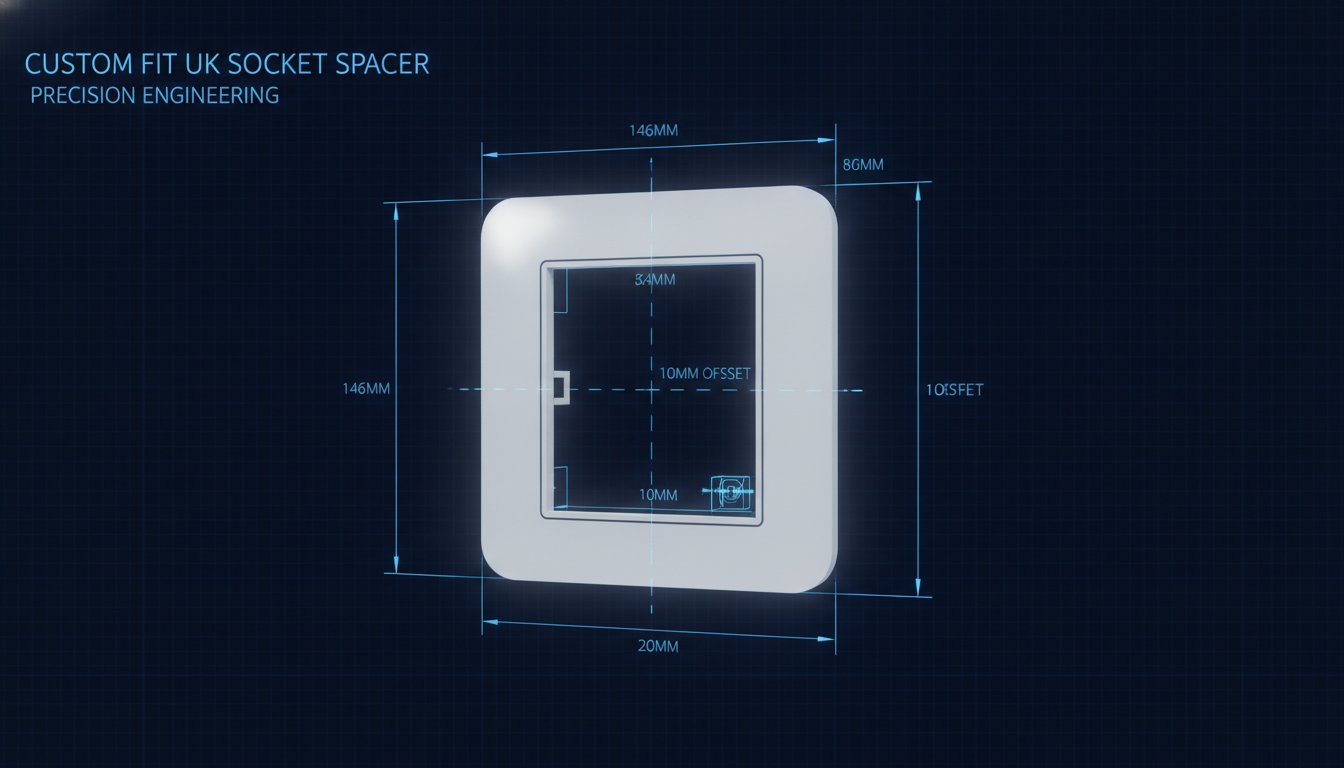
A standard socket spacer is often the weak link in an otherwise high-end renovation, leaving you with a finish that feels like a compromise rather than a professional installation. You've likely spent considerable time selecting the perfect grey or black faceplates, only to find they sit recessed in the plaster or feel unstable because the backbox is set too deep. It's a common technical frustration that compromises both the aesthetic and the safety of your electrical installation, especially when faceplates don't sit firmly against the wall surface.
This guide explores how bespoke plastic socket spacers provide the precision depth and professional finish that standard hardware simply cannot match. You'll discover how custom-made solutions solve the problem of limited wiring space for smart home modules and ensure your sockets sit perfectly flush against any wall surface. If you're ready to achieve a millimetre-perfect result for your project, you can use the Build My Spacer configurator tool to specify the exact dimensions your installation requires. We'll examine why tailoring your hardware is the only way to guarantee a secure, colour-matched finish for modern interiors whilst maintaining the structural integrity of your electrical fittings.
Key Takeaways
- Learn why standard off-the-shelf spacers often fail to provide the exact depth needed for a flush finish in modern renovations.
- Discover how bespoke plastic socket spacers eliminate the instability and poor alignment caused by stacking multiple thin, generic frames.
- Explore solutions for complex multi-gang setups and media walls that require increased wiring space for bulky smart home modules.
- Master the precise measurement techniques required to order a perfect fit using the Build My Spacer configurator tool.
- Understand the benefits of using UK-manufactured, made-to-order spacers to achieve a seamless colour match for your specific electrical faceplates.
Table of Contents
- What Are Bespoke Plastic Socket Spacers and Why Do They Matter?
- Bespoke vs Standard: Solving the In-Between Depth Problem
- Beyond Single Sockets: Bespoke Frames for Complex Installations
- How to Measure and Order Your Bespoke Plastic Spacers
- SocketSpacers.com: The UK Specialist in Made-to-Order Spacers
What Are Bespoke Plastic Socket Spacers and Why Do They Matter?
A bespoke plastic socket spacer is a made-to-order frame designed to bridge the physical gap between a recessed electrical backbox and the decorative faceplate. While standard hardware stores offer generic plastic rings, these often fail to meet the exact requirements of a modern UK renovation. A bespoke solution is manufactured to specific dimensions, ensuring that your sockets and switches sit perfectly flush against the finished wall surface. This level of precision is essential when working with high-end materials like marble splashbacks, acoustic timber panelling, or thick decorative plasterwork.
The Problem of the Sunken Backbox
In many properties, the original electrical installation assumes a standard plaster finish. When you add a layer of tiling or decorative panelling, the backbox becomes sunken within the wall. This depth deficit makes it difficult for the faceplate screws to reach the mounting lugs. To understand the foundation of this issue, it helps to know what a pattress box is and how it serves as the internal housing for your wiring. If the faceplate is simply pulled forward using longer screws without a support frame, it creates an unsightly recessed look. This leaves an open gap behind the plate, which is particularly noticeable on kitchen splashbacks where a professional, seamless finish is the expected standard.
Safety and Structural Integrity
Beyond aesthetics, bespoke plastic socket spacers play a critical role in maintaining the mechanical safety of an installation. A socket that lacks a solid mounting surface is effectively floating. Every time you plug in or remove a device, the faceplate flexes. This repeated movement puts significant mechanical stress on the copper wiring and the screw terminals. Over time, this can lead to loose connections, which are a primary cause of electrical arcing and overheating. These risks are avoidable with the correct hardware.
By using a tailored spacer, you provide a rigid shoulder for the faceplate to sit against. This creates a solid, stable mounting that mimics the original wall surface. Ensuring a rigid mounting aligns with the spirit of UK electrical safety standards, as it prevents the vibration and movement that compromise wiring integrity. If you are dealing with a non-standard wall depth, you can specify your requirements using the Build My Spacer tool to ensure your installation is both beautiful and safe. These spacers are designed to provide a permanent, professional solution rather than a temporary fix.
Bespoke vs Standard: Solving the In-Between Depth Problem
Standard trade centres and electrical wholesalers typically stock spacers in fixed increments, usually 10mm or 20mm. While these work for basic installations, they rarely account for the specific realities of modern interior design. If your project involves a 6mm metro tile combined with a 2mm bed of adhesive, a 10mm standard spacer will leave your socket protruding from the wall. Conversely, a 5mm spacer would leave the socket recessed. This "in-between" depth problem is where off-the-shelf hardware fails to provide a professional result.
Tradespeople often attempt to solve this by stacking multiple thin spacers together. This approach is fundamentally flawed. Stacking creates multiple points of potential failure and makes it difficult to maintain a perfectly level alignment. A single-piece bespoke plastic socket spacers solution provides a continuous, solid surface that eliminates the "spongy" feel of stacked components. It also significantly increases installation speed. Instead of faffing with multiple parts, you simply slide one tailored frame into place and tighten the screws.
The Math of a Perfect Flush Finish
Achieving a luxury finish requires precise calculation. You must measure the distance from the rim of the backbox to the finished wall surface. Small variations matter. A difference of just 1mm can be the difference between a faceplate that sits tight against the wall and one that shows a shadow gap. Common scenarios like 12mm decorative panelling or 9mm moisture-resistant plasterboard often require specific depths that generic manufacturers don't provide. By ordering exact depths, you ensure the faceplate makes full contact with the wall without putting undue pressure on the plaster or the electrical terminals.
Stability and Material Performance
The material quality of your spacer is just as important as its dimensions. Flimsy, mass-produced moulded alternatives can warp or compress when the faceplate screws are tightened. Our spacers are manufactured from high-quality plastic that offers excellent resistance to compression. This ensures the spacer maintains its structural integrity over time, even in high-traffic areas like kitchens and hallways where sockets are frequently used.
Using a single, solid component also ensures compliance with the mechanical requirements of UK safety regulations, which demand that electrical equipment is installed in a way that prevents dangerous movement. If you need a specific depth between 2mm and 30mm for your project, you can easily configure a custom solution using the Build My Spacer tool. For those managing multiple rooms, choosing bespoke socket spacers ensures consistency and a high-end finish across the entire property.
Beyond Single Sockets: Bespoke Frames for Complex Installations
The trend towards integrated technology in modern UK homes has led to a significant rise in multi-gang electrical configurations. Media walls, home office hubs, and kitchen control centres often feature triple or quadruple arrays that house power, data, and satellite points in a single row. Standard off-the-shelf spacers are almost exclusively manufactured for single or double gang fittings, leaving installers with a difficult challenge when a multi-gang backbox is recessed. Attempting to align several individual spacers is time-consuming and often results in a jagged, unprofessional finish.
Using bespoke plastic socket spacers specifically designed for multi-gang arrays ensures that the entire row of fittings remains perfectly level and secure. These custom frames are manufactured as a single continuous piece, providing a uniform mounting surface across the entire width of the installation. This is particularly important for media walls where the aesthetic impact of a misaligned socket is amplified by high-end finishes. These bespoke solutions also accommodate non-standard corner radii and specific fixing lug positions that generic alternatives ignore. If your project involves a non-standard configuration, you can specify the exact dimensions and gang count through the Build My Spacer tool to ensure a millimetre-perfect fit.
Addressing the Smart Home Space Deficit
Modern electrical fittings are increasingly bulky. Smart home modules, wireless dimmers, and USB-integrated sockets require significantly more depth within the wall than traditional switches. If a backbox is too shallow, forcing these components into the space can compress the wiring, which is a direct violation of the safety principles outlined in the IET Wiring Regulations. These regulations emphasise the importance of avoiding mechanical stress on cables and connections. A bespoke spacer acts as an extension frame, providing the necessary increased wiring space without the need to excavate a deeper hole in the masonry or stud wall.
Aesthetic Customisation: Colour and Texture
The visual success of a luxury renovation often depends on the details that go unnoticed. Premium faceplates in anthracite, brushed chrome, or matt black are frequently chosen to complement specific interior palettes. If a standard white spacer is used behind a dark faceplate, the resulting white "halo" ruins the high-end look. Bespoke manufacturing allows for colour matching in White, Grey, and Black, ensuring the hardware either blends seamlessly or creates a deliberate, professional shadow gap effect. This attention to detail ensures that the spacer remains a functional part of the installation rather than an unsightly distraction. By selecting a colour that matches the faceplate, you achieve a finish that looks like a deliberate design choice rather than a corrective measure.

How to Measure and Order Your Bespoke Plastic Spacers
Precision is the foundation of a high-quality electrical finish. To achieve a result that looks integrated rather than added on, you must provide exact measurements during the ordering process. While a standard tape measure might suffice for general DIY tasks, ordering bespoke plastic socket spacers requires a higher level of accuracy. Using a pair of vernier calipers or a dedicated depth gauge is the most reliable method to ensure your custom frames fit perfectly on the first attempt. These tools allow you to measure to the nearest millimetre, which is essential when dealing with thin tiles or delicate wall panelling.
Step-by-Step Measurement Guide
Safety must be your first priority. Isolate the power at the consumer unit before removing the faceplate screws to access the backbox. Once the faceplate is safely pulled forward, you can see the gap between the rim of the backbox and the finished wall surface. It is common for walls to be slightly uneven, particularly in older properties or where plaster has been applied by hand. You should measure the depth at all four corners of the backbox to identify any discrepancies. Always choose the smallest measured depth to ensure a flush fit. This prevents the spacer from being too proud of the wall, which would cause the faceplate to tilt or leave a gap at the edges.
Next, identify the gang size required for your installation. Standard UK fittings are typically Single Gang (1G) at 86mm x 86mm or Double Gang (2G) at 146mm x 86mm. If you are working with a media wall or a bespoke control panel, you may need multi-gang spacers or even a large extension frame. Check the corner radius of your faceplates; some modern designs have sharp, square corners whilst others are heavily rounded. Ensuring your spacer matches these contours prevents the plastic from peeking out from behind the decorative plate.
Avoiding Common Ordering Mistakes
A frequent error is confusing the internal dimensions of the backbox with the external footprint of the faceplate. Your spacer needs to sit behind the faceplate, acting as a bridge. If the spacer is too large, it will be visible around the edges of the socket. If it is too small, it won't provide a stable mounting shoulder for the lugs. You should also account for screw creep. When using extra-long electrical screws to reach a sunken box, the screws can sometimes pull the faceplate slightly deeper into the spacer material than anticipated. Verifying your measurements twice before committing to manufacture is the best way to avoid waste and ensure a drop-in fit upon delivery.
Once you have your dimensions ready, you can easily input them into the Build My Spacer configurator. This tool allows you to select the gang size, depth, and colour to match your specific project requirements. If you are ready to eliminate recessed sockets for good, order your custom socket spacers here to guarantee a professional, millimetre-perfect finish.
SocketSpacers.com: The UK Specialist in Made-to-Order Spacers
SocketSpacers.com stands apart from general retailers by focusing exclusively on solving specific technical installation challenges that standard hardware ignores. While mass-market imports from platforms like Amazon typically offer only generic, one-size-fits-all hardware, we provide a specialist service that prioritises precision and material quality. Our bespoke plastic socket spacers are manufactured right here in the UK, ensuring that every component meets our rigorous quality standards before being shipped nationally. This local manufacturing approach allows us to react quickly to the needs of both homeowners tackling a single DIY fix and contractors managing large-scale commercial renovations. By focusing on this niche, we've developed a deep understanding of the spatial frustrations encountered during modern building projects.
Precision Engineering for Every Order
Our manufacturing process is designed to accommodate the exact specifications of your project, no matter how non-standard the depth may be. We have the capability to produce spacers in depths ranging from 2mm up to 30mm with millimetre-perfect accuracy. This is a level of customisation that standard trade centres simply cannot match with their limited stock of 10mm or 20mm rings. Whether you require a single gang frame or bespoke large extension frames for complex control panels, our equipment is calibrated to deliver a drop-in fit every time. This precision ensures that even the most sunken backboxes can be extended safely, providing a solid foundation for your electrical fittings. You can specify these exact requirements using the Build My Spacer configurator tool to get a tailored solution for your wall depth.
Why Professionals Choose SocketSpacers.com
For electricians and interior fit-out specialists, reducing time on site is a critical factor in project profitability. Traditional "hack" solutions, such as stacking multiple thin spacers or using excessive amounts of filler to hide gaps, are inefficient and often lead to expensive callbacks. By using our bespoke plastic socket spacers, professionals can achieve a perfect, flush finish in a fraction of the time. The reliability of a single-piece, solid frame provides a superior mounting surface that won't compress or warp as the faceplate screws are tightened. This professional-grade durability ensures that the installation remains secure for years, even in high-use environments. To see the full range of possibilities for your next installation, you can browse our bespoke spacer range and find the exact technical solution for your project needs.
Achieving the Perfect Electrical Finish
A professional finish is defined by the details that often go unnoticed by the untrained eye. By choosing bespoke plastic socket spacers, you eliminate the visual and structural compromises inherent in generic, off-the-shelf hardware. We have explored how precision depths ranging from 2mm to 20mm ensure a flush fit against any wall surface, whether it is a kitchen splashback or decorative timber panelling. These UK-manufactured solutions provide the necessary stability to prevent mechanical stress on your wiring, ensuring your installation remains safe and secure whilst maintaining a seamless aesthetic.
If you are dealing with sunken backboxes or complex multi-gang arrays, there is no longer a need for unstable "hack" solutions. You can use the Build My Spacer configurator tool to specify the exact dimensions and colours your project requires. As specialists in solving electrical depth issues, we are here to help you achieve a millimetre-perfect result that standard hardware simply cannot match. Order Your Bespoke Plastic Socket Spacers Today to give your property the high-quality finish it deserves. Your renovation project is now ready for its final, perfect touch.
Frequently Asked Questions
Can I stack standard 10mm spacers to reach a 20mm depth?
Stacking generic 10mm spacers is not a recommended solution because it introduces multiple movement points and compromises the stability of the installation. This approach often leads to a "spongy" socket that flexes whenever a plug is inserted or removed. A single-piece bespoke plastic socket spacers frame provides a continuous, solid mounting shoulder that ensures the faceplate remains rigid and perfectly aligned with the wall surface.
Are bespoke plastic socket spacers fire-rated or heat-resistant?
These spacers are manufactured from PLA plastic, which is designed to provide mechanical support and bridge the gap to the wall surface. It is important to remember that the backbox itself remains the primary fire-rated enclosure for the electrical connections. By providing a secure mounting, the spacer prevents the loose connections and mechanical stress that are the leading causes of electrical arcing and overheating.
What is the maximum depth available for a bespoke extension frame?
We can manufacture bespoke extension frames in custom depths ranging from 2mm up to a maximum of 30mm. This extensive range allows you to solve almost any depth deficit caused by thick kitchen tiles, acoustic panelling, or deeply recessed backboxes. You can specify your exact depth requirements to the millimetre using the Build My Spacer tool to ensure your faceplate sits perfectly flush.
Do I need longer screws when using a bespoke socket spacer?
You will almost certainly require longer M3.5 electrical screws to account for the added depth of the spacer. The screw must be long enough to pass through the faceplate and the spacer to reach the threaded lugs inside the backbox. Whilst standard 25mm screws are often sufficient for flat walls, you will typically need 40mm, 50mm, or even 75mm screws for deeper bespoke installations.
How do I fix a socket that is too deep after tiling in the kitchen?
The most professional way to fix a recessed kitchen socket is to install a bespoke spacer that matches the combined thickness of your tiles and adhesive. You should measure the distance from the backbox rim to the finished tile surface at all four corners. Ordering a tailored frame based on these measurements provides a stable mounting surface and eliminates the unsightly gap behind the faceplate.
Can bespoke spacers be used for light switches as well as plug sockets?
Yes, bespoke spacers are designed to work with both light switches and plug sockets as they share standard UK gang dimensions. Whether you are installing a single gang dimmer switch or a double gang power outlet, the spacer acts as a universal extension frame. This ensures a consistent, high-quality finish across your entire property, regardless of the type of electrical fitting being used.
What colours are available for bespoke plastic spacers?
Our bespoke plastic spacers are available in white, grey, and black to ensure a professional match with your chosen electrical faceplates. Selecting a matching colour is essential for high-end renovations, as it prevents an unsightly white border from showing around dark or metallic sockets. This level of aesthetic customisation ensures the hardware remains a discreet and functional part of the interior design.
How long does it take to manufacture and deliver a made-to-order spacer?
As a specialist UK manufacturer, we process and produce all made-to-order spacers within a few working days. Because we manufacture every order to your specific dimensions in-house, we can maintain high quality control whilst offering fast national shipping. This allows you to receive a precision-engineered solution for your sunken backboxes without causing significant delays to your project timeline.
Electrical Safety
Always isolate the circuit and confirm it is dead before removing a socket or switch faceplate. Only carry out the work if you are competent to do so. If you find damaged wiring, signs of overheating or anything unsafe, stop and contact a qualified electrician.